Black History: Mary McLeod Bethune — Justice Through Education
Learning from Faith, Courage, and Community Builders
Every February, we reflect on the lives of Black leaders whose faith, perseverance, and love for their communities continue to shape our city today. Their stories remind us that faith and action go hand in hand—and that lasting change happens through prayer, service, and faithful presence.
Each week, we’ll add a new reflection as part of our Black History Month series.
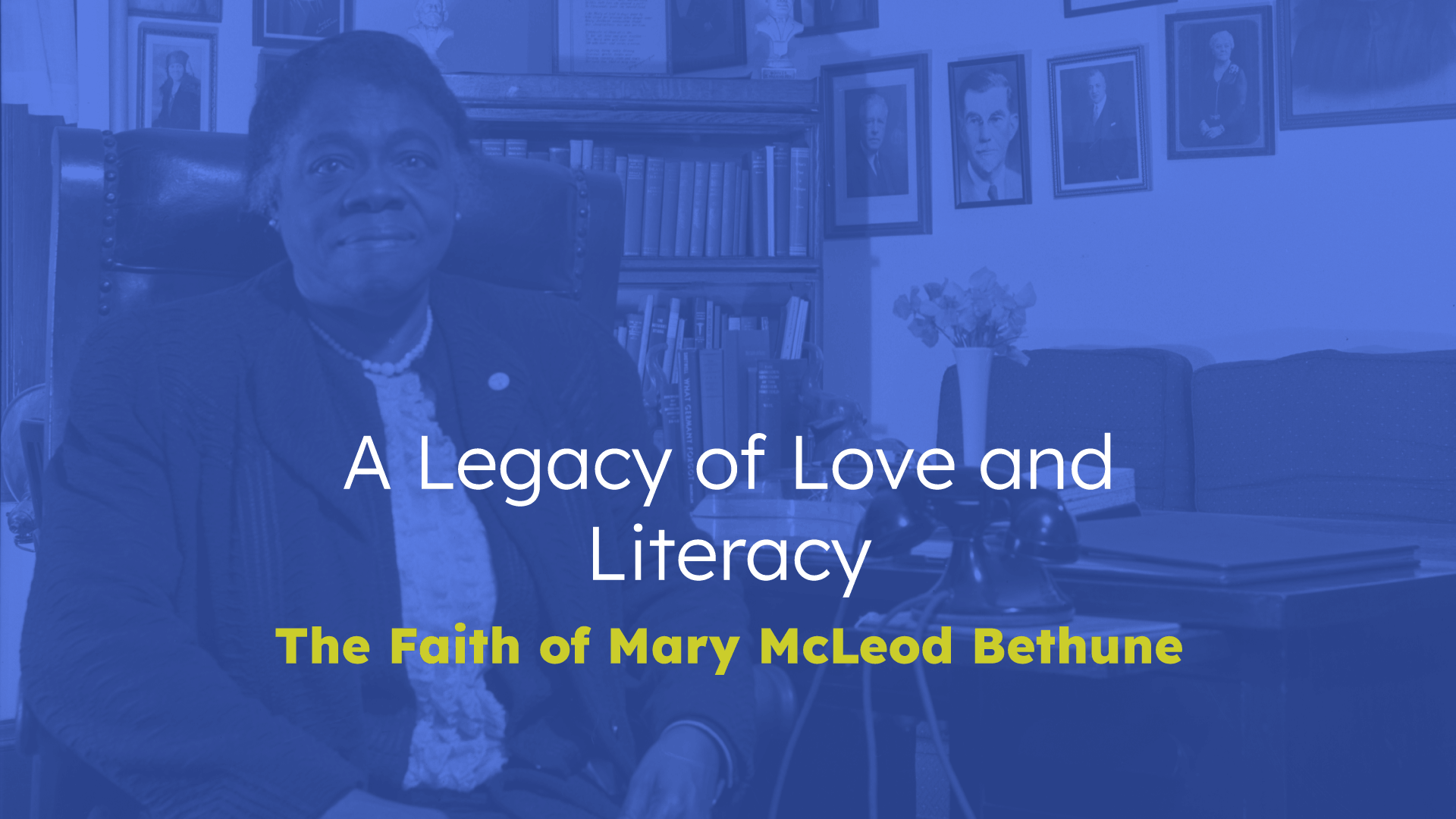
As we continue our citywide celebration of Black History Month, we move from the quiet laboratory of George Washington Carver to the front lines of education and advocacy. If Seymour showed us the power of prayer and Carver showed us the beauty of stewardship, Mary McLeod Bethune (1875–1955) shows us that justice is what love looks like in public.
The daughter of formerly enslaved parents, Bethune was the only one of 17 siblings to attend school. That opportunity didn't just change her life; it ignited a lifelong conviction that education is a fundamental tool for liberation and a requirement for a flourishing city.
Building on a Foundation of Faith
In 1904, with just $1.50, five little girls, and a mountain of faith, she started the Daytona Normal and Industrial Institute for Negro Girls in Florida. She famously made ink from elderberries and used charred wood for pencils. When people asked how she could build a college with nothing, she replied, "I poured my heart into it, and I looked up."
Her faith was the engine of her advocacy. She didn't just want to teach children to read; she wanted to change the systems that kept them in the dark. She became a trusted advisor to U.S. Presidents, founded the National Council of Negro Women, and led the "Black Cabinet" under FDR. She believed that because every person was created in the image of God, every person deserved a seat at the table.
Justice as a "Big C" Church Priority
Bethune often spoke of the importance of the universal body of believers working together. She famously said, "Any idea that keeps anybody out is too small for this age." This is the heart of our work at Unite KC. Justice isn't about taking sides; it's about expanding the circle of who we care for until no one is left out.
Her advocacy wasn't limited to the classroom. She registered Black voters despite threats from the KKK, fought for anti-lynching legislation, and challenged discriminatory policies at every level. She understood that true education meant equipping people not just to survive, but to transform their communities.
Why Bethune Matters for Kansas City Today
In our recent 2025 Impact Report, we shared a sobering reality: 77% of Kansas City third-graders are not reading at grade level. For Mary McLeod Bethune, this wouldn't just be an educational statistic; it would be a call to spiritual battle.
At Unite KC, we believe literacy is a justice issue. As we look toward 2026, we are mobilizing 500+ Christian adult readers to spend one hour a week with a student. We aren't just teaching them to decode words; we are advocating for their future and their God-given potential, just as Bethune did over a century ago.
Our Call to Action:
In her "Last Will and Testament," Bethune wrote: "I leave you love. I leave you hope. I leave you a thirst for education."
This week, let's honor her legacy by asking:
Who is being left out of the flourishing of our city?
How can we use our "seat at the table" to advocate for those who have none?
Will you join us in the fight against illiteracy by becoming a reading mentor?
When we invest in the education of a child, we are standing on the shoulders of Mary McLeod Bethune and participating in the shalom of Kansas City.